
• Skip to main content
  • Skip to navigation
  • Accessibility
  • Contact Us
Government of Western Australia Crest
Government of Western Australia
Government of Western Australia Crest

Additional Menu

  • Accessibility
  • Contact us
Go to WA Government search
  • For patients and visitors
    • Emergencies
    • Aishwarya's CARE Call
    • Coming to Fiona Stanley Hospital
      • Visiting our hospitals
      • Finding your way
      • Maps
      • Facilities
      • Parking and transport
    • Coming to Fremantle Hospital
      • Visiting our hospitals
      • Map of Fremantle Hospital
      • Facilities
      • Parking and transport
    • Coming to Cockburn Health
      • Visiting our hospitals
      • Parking and transport
      • Maps of Cockburn Health
    • Visiting our hospitals
    • Being a patient
      • Understanding your surgical journey
      • Your hospital admission
      • Understanding where you will receive care
      • During your hospital stay
      • Ordering patient meals
      • Elective surgery
      • Outpatients
      • Private patients
      • Treatment costs for overseas visitors and students
      • Going home from hospital
    • Support during your stay
      • Pastoral care
      • Peer support workers
      • Supporting Aboriginal patients and families
      • Supporting people with disability
    • Keeping you safe
      • Reduce your risk of falls – Be SAFER
      • Preventing pressure injuries
      • About good hand hygiene
      • Preventing healthcare associated infections
    • Managing your health care
      • Patient rights
      • Goals of patient care
      • Talk about 'What matters to you?'
      • MySay healthcare survey
    • Easy read resources
    • For families and carers
      • Pastoral care
      • Supporting carers
      • Supporting Aboriginal patients and families
      • Supporting patients with cognitive impairment
      • Understanding delirium
      • If you can't visit an older patient
      • The intensive care journey
      • After the loss of a loved one
    • Freedom of information
    • Feedback compliments and complaints
  • For health professionals
    • Information for GPs
      • SMHS GP Engage
    • Refer a patient
      • Service specific referrals
    • Library and Information Service
  • Our services
  • Our community
    • Volunteer with us
    • Consumer Advisory Council
    • 'Put it to the People' engagement platform
    • ED Consumer Advisory Group
    • Mental Health Consumer Advisory Group (Fremantle Hospital)
    • Pulse
  • Our research
  • Work with us
    • Career opportunities
      • Aboriginal workforce
      • Allied Health
      • Corporate non-clinical
      • Graduates
      • Medical
      • Mental health
      • Nursing and midwifery careers
    • Fellowships
      • Anaesthesia and Pain Medicine
      • Medical Imaging Fellowships
    • Living in WA
  • News
  • About us
    • About FSFHG
    • About South Metropolitan Health Service
    • Feedback, compliments, concerns and complaints
    • Conduct and standards
    • Contact us
    • Executive
    • Our vision and values
    • Our history
    • Our Aboriginal heritage
  1. Home
  2. News
  3. 2026
  4. 04
  5. 30
  6. Fiona Stanley Hospital trial gives myeloma patient new strength, sparks call for early health checks
Fiona Stanley Hospital trial gives myeloma patient new strength, sparks call for early health checks

Fiona Stanley Hospital trial gives myeloma patient new strength, sparks call for early health checks

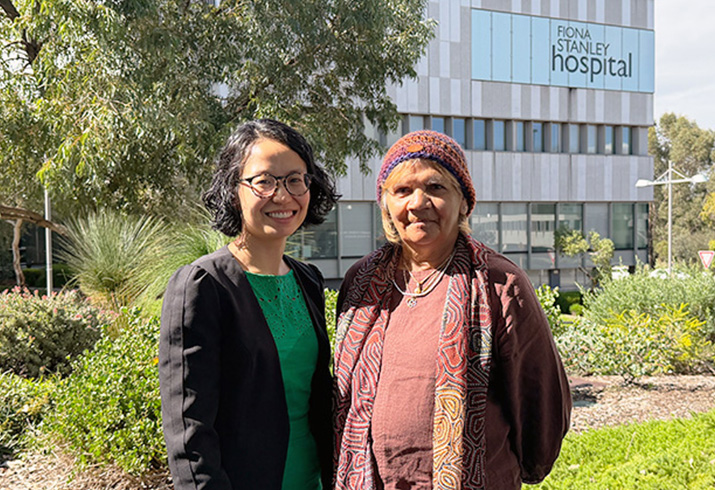
Dr Stephanie Lam stands outside with Aboriginal patient Loreta. The Fiona Stanley Hospital building is in the background
30/04/2026

After experiencing the impact of a new clinical trial at Fiona Stanley Hospital, myeloma patient Loreta Hill is encouraging other Aboriginal people to prioritise their health and seek help from healthcare professionals.

“Cancer is daunting. I think people need to be aware of their health,” Loreta said.

“If you’re not well, go and seek help but always have your close family by your side.”

Loreta, who has myeloma, said her message to Aboriginal people was about not putting off medical care and knowing that help, including clinical trials, is available.

Her call comes as she has had life-changing care through a clinical trial investigating CAR T‑cell therapy for people with myeloma, a rare but incurable blood cancer that often requires ongoing treatment over many years.

Before joining the trial, Ms Hill said her initial treatment was physically exhausting and took a significant toll on her daily life.

“I was quite sick and very weak. You just can’t do anything. Your body, sometimes it just shuts down,” she said.

“The first treatment I was bedridden. I lost my hair, and it just drained me.”

Her treatment involved weekly hospital visits and long periods of recovery, leaving little energy for everyday activities or family life.

That experience changed dramatically when Loreta joined the CAR T‑cell clinical trial. Instead of ongoing treatment, she received a single infusion of the therapy and now only needs to return to hospital once a month for check‑up appointments.

“I can now stay home and help with my grandkids and do things that I love, like going to watch my grandies play football and sports,” she said.

The clinical trial is examining whether CAR T‑cell therapy can provide patients with more time away from hospital and fewer side effects compared with standard treatments. Myeloma is considered treatable but incurable, which means many patients must move from one treatment to another as the disease relapses.

CAR T‑cell therapy involves collecting a patient’s own T‑cells, a type of white blood cell, which are then sent overseas to be genetically modified to better recognise and destroy cancer cells. The modified cells are later infused back into the patient as a one‑off treatment, followed by ongoing monitoring rather than continuous therapy.

Fiona Stanley Hospital Consultant Haematologist Dr Stephanie Lam said the therapy had already shown the potential to reduce the time patients spend in hospital.

“Most myeloma treatments are given forever more, until they either stop working or the patient gets side effects, and we have to stop it,” Dr Lam said.

“Whereas CAR-T you give it and then we just monitor them.”

Dr Lam said if the therapy proves more effective than standard care, it could become more widely available beyond the clinical trial setting.

“We’re hopeful that there will be commercial access to CAR-T by the end of the year,” she said, noting that current approval pathways are usually limited to patients who have already undergone multiple lines of treatment.

Loretta said she hoped her experience would encourage Aboriginal people to look after their health and to know that support and care were available from the ‘beautiful’ hospital staff.

“The staff here at the hospital have all been beautiful – just beautiful,” said Loreta.

Keep up to date with our news and achievements

Find out more on Facebook (external site) or LinkedIn (external site)

Previous Next
Last Updated: 30/04/2026
  • Facebook
  • LinkedIn

Footer menu

  • wa.gov.au
  • Copyright
  • Disclaimer
  • Privacy
  • Sitemap
  • Contact Us

Brought to you by the Department of Health, Western Australia

© Government of Western Australia 2018 to