

Fiona Stanley Hospital’s expert care results in baby Senan’s safe arrival
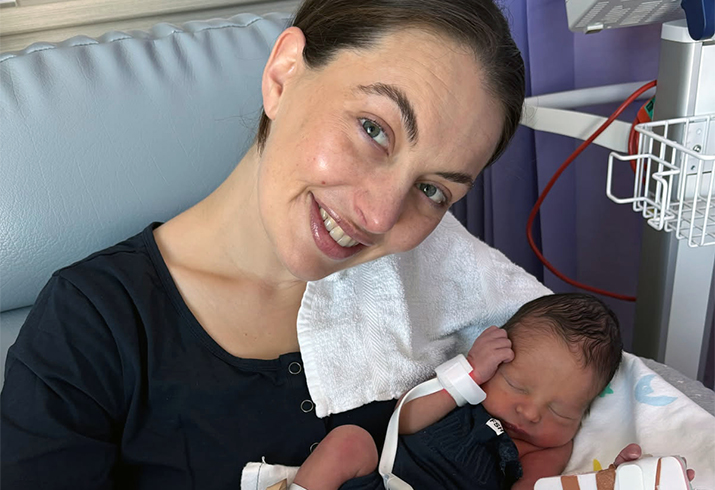 Katie and her baby son Senan
For Katie, holding her baby safely in her arms after a high-risk pregnancy and complex caesarean under general anaesthetic, was a moment she’ll never forget.
During her second pregnancy, Katie was diagnosed with placenta accreta spectrum (PAS) – a rare but serious condition where the placenta grows too deeply into the wall of the uterus. Without careful planning and expert care, PAS can lead to life-threatening complications, including severe haemorrhage during birth.
“I was shocked to discover I had PAS at a 28-week ultrasound,” Katie said.
But Katie wasn’t facing it alone.
At Fiona Stanely Hospital, a highly coordinated multidisciplinary team worked together to plan and deliver her care, bringing together specialists across obstetrics, interventional radiology, urology, neonatology and anaesthetics.
Thanks to this team approach, Katie was able to safely welcome baby Senan into the world at 36 weeks' gestation.
“Senan went to the Neonatal Intensive Care Unit accompanied by his dad, and after 24 hours of recovery I was able to meet him, which was a really emotional moment,” Katie said.
In January 2025, the hospital formally launched its dedicated PAS Service, designed to care for women with one of the most complex conditions in obstetrics.
While the condition remains uncommon, its frequency is increasing both in Australia and globally.
The condition can involve the placenta growing into surrounding organs such as the bladder, making surgery significantly more complex and increasing the risk of complications.
The PAS Service brings together specialist expertise to manage these risks through detailed planning and coordinated care – before, during and after birth.
The service includes advanced obstetric surgeons leading complex procedures such as caesarean hysterectomy, maternal–fetal medicine specialists coordinating pregnancy care and timing of delivery and urologists supporting safe surgery where the bladder or urinary tract is involved. Additionally, interventional radiologists assist with haemorrhage control, with Fiona Stanley Hospital currently the only centre in Western Australia offering prophylactic internal iliac balloon occlusion (PIIABO). Furthermore, the service includes neonatologists providing care for premature and high-risk newborns, anaesthetists experienced in complex obstetric cases and critical care, perfusionists and specialised nursing and midwifery teams supporting surgery and recovery.
This service also offers a dedicated PAS pathway, supporting women from diagnosis through to recovery. This includes a specialised antenatal clinic, continuity of care with the same clinical team where possible and ongoing follow-up focused on both the physical and emotional recovery.
For patients like Katie, this level of coordinated care made all the difference – reducing risks, improving outcomes and ensuring women feel supported every step of the way.
“I feel really lucky to have been able to access this specialised service and hope more women are able to hold their babies safely in their arms like me,” Katie said.
Mother’s Day is celebrated on 10 May 2026. South Metropolitan Health Service is privileged to help and support mothers on their pregnancy, birth and parenting journey.
Keep up to date with our news and achievements
Find out more on Facebook (external site) or LinkedIn (external site)