

About bone conduction implants
A bone conduction implant is a small device that helps people with certain types of hearing loss to hear sounds. It is used when hearing aids cannot be worn or do not provide enough benefit.
Bone conduction implants are used by both children and adults worldwide.
If you or a loved one has severe to profound hearing loss that is not helped enough by hearing aids, your doctor may refer you to the Statewide Tertiary Adult Audiology Service for a bone conduction implant assessment.
Paediatric services are provided at Fiona Stanley Hospital and Fremantle Hospital. These services are also available to paediatric patients living within the SMHS catchment (PDF 2MB) at Fiona Stanley Hospital and Fremantle Hospital.
Why you may need a bone conduction implant
Hearing loss often happens when sound is blocked or cannot travel effectively through the outer or middle ear to reach a healthy inner ear. This may be because you have:
- a condition affecting your outer ear, such as chronic ear infections, and/or ear abnormalities
- problems with your middle ear (your ear drum and middle ear bones).
When this pathway is blocked or not working:
- making sounds louder with hearing aids may not help
- speech can become unclear, even when sounds are loud enough.
How it works
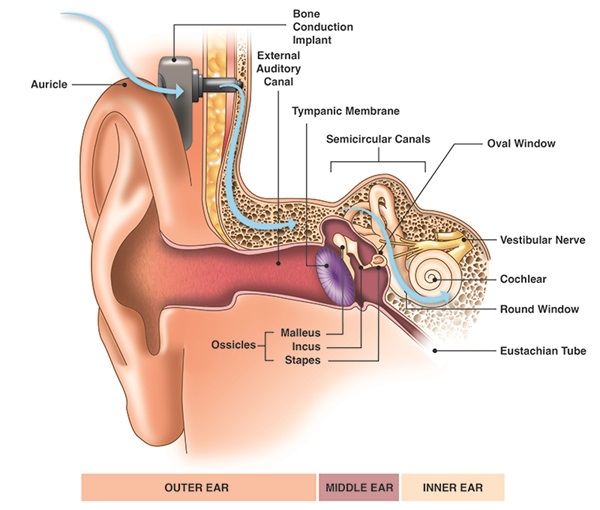
A bone conduction implant sends sound vibrations directly through the bone of the skull to your inner ear, bypassing the damaged or blocked outer and middle ear.
It has two main parts:
- an internal implant – this is placed under the skin during surgery and includes a fixture or magnet that sits in the bone behind your ear
- an external sound processor – worn behind or on the bone behind your ear, this picks up sound and converts it to vibrations which are sent to the implant.
Both parts are needed for the implant to work.
As the implant does not use your ear canal, eardrum or middle ear bones, it does not matter if these are damaged or blocked.
How it differs from a hearing aid
How hearing aids and bone conduction implants work – and how they help you hear – are quite different
Fitting
Hearing aid: fitted by your hearing care provider in their office.
Bone conduction implant: surgically implanted in hospital by an ear, nose and throat (ENT) specialist, and then programmed by a specialist audiologist.
How it works
Hearing aid: makes sound louder but relies on a clear pathway through the outer and middle ear.
Bone conduction implant: sends vibrations directly through the skull bone to the inner ear, bypassing the outer and middle ear.
Signal type
Hearing aid: acoustic signal (sound waves).
Bone conduction implant: vibrational (mechanical) signal.
Access to sound
Hearing aid: depends on the health of your inner ear cells and openness of the ear canal and middle ear.
Bone conduction implant: provides access to sound regardless of issues with your ear canal, eardrum or middle ear bones.
How quickly it works
Hearing aid: effective almost immediately
Bone conduction implant: you will need to hear for between four to eight weeks after surgery before the processor can be attached. You will hear sound immediately after fitting but it will take your brain some time to adapt.
Hearing and listening exercises (rehabilitation)
Hearing aid: little formal rehabilitation is needed.
Bone conduction implant: hearing exercises are beneficial. Consistent daily use is key for the brain to adapt.
How you wear it
Hearing aid: an ear mould or dome sits within the ear canal, connected to a hearing aid which sits behind the ear.
Bone conduction implant: A sound processor sits directly on the bone behind the ear, held by a magnet or abutment. Nothing sits in the ear canal.
Learn about a bone conduction implant assessment
Read what to expect at bone conduction implant assessment and how to get referred to the Statewide Tertiary Adult Audiology Service.
Your appointment letter will note the location of your outpatient appointment.
Read how to manage your outpatient appointment using the Manage my Care app.
Fiona Stanley Hospital patients
Call the Fiona Stanley Helpdesk on 6152 2222 and ask for your specific clinic or audiologist.
Outpatient clinics are located on the ground floor of the main hospital building, off the main concourse. The main entrance to the hospital is accessed off Robin Warren Drive – view the Fiona Stanley Hospital map (PDF 1MB).
Fremantle Hospital patients
Call the Fremantle Hospital switchboard on 9431 3333 and ask for your specific clinic or audiologist.
Please go to B Block Level 4, Fremantle Hospital, Alma St Fremantle – view the Fremantle Hospital map (PDF 675KB).
Royal Perth Hospital patients
Call Royal Perth Hospital switchboard on 9224 2244 and ask for your specific clinic.
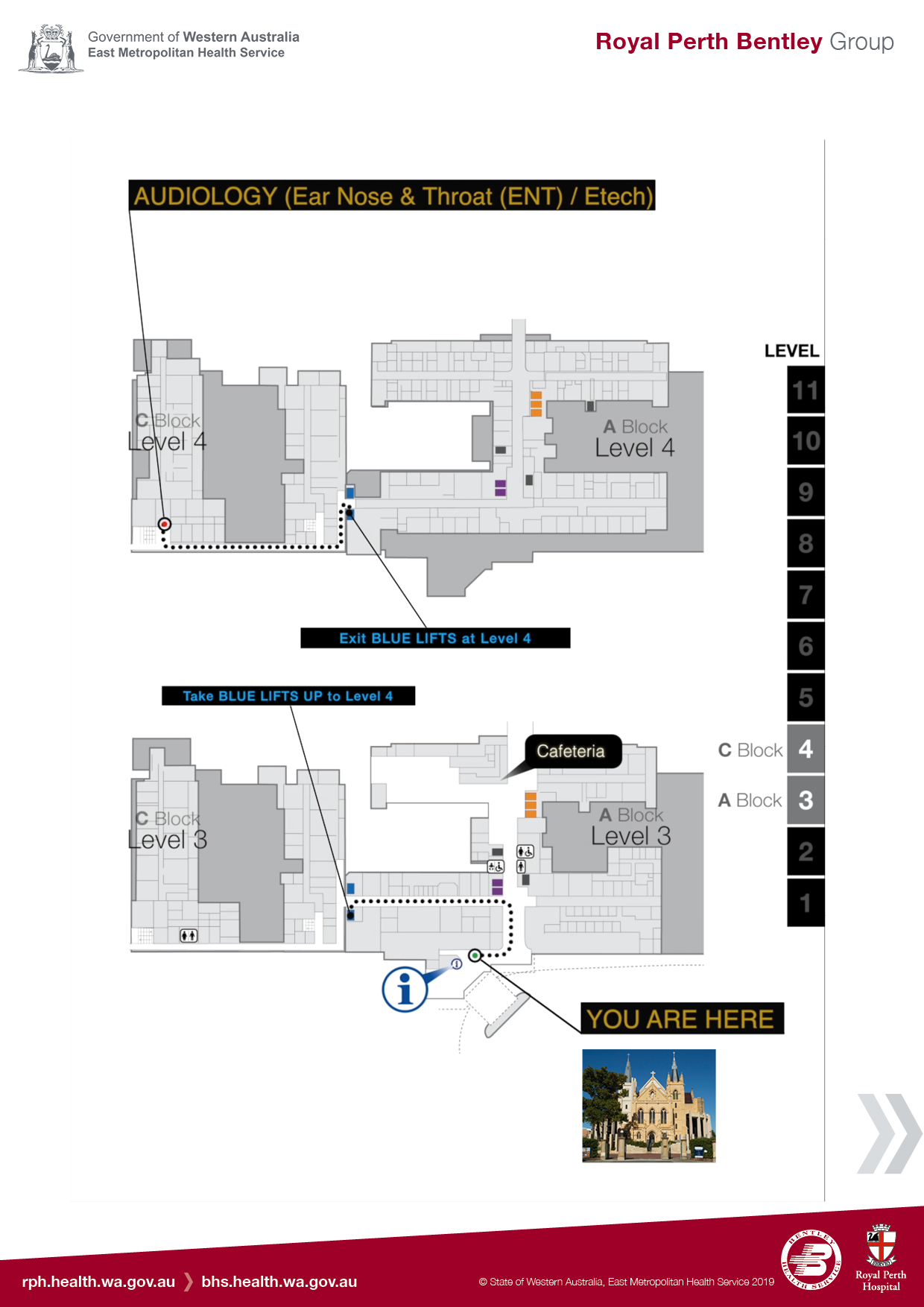
The Outpatient Audiology and ENT Department is located Level 4, Nicholay Block – see the Royal Perth Hospital map (external site).
Sir Charles Gairdner Hospital patients
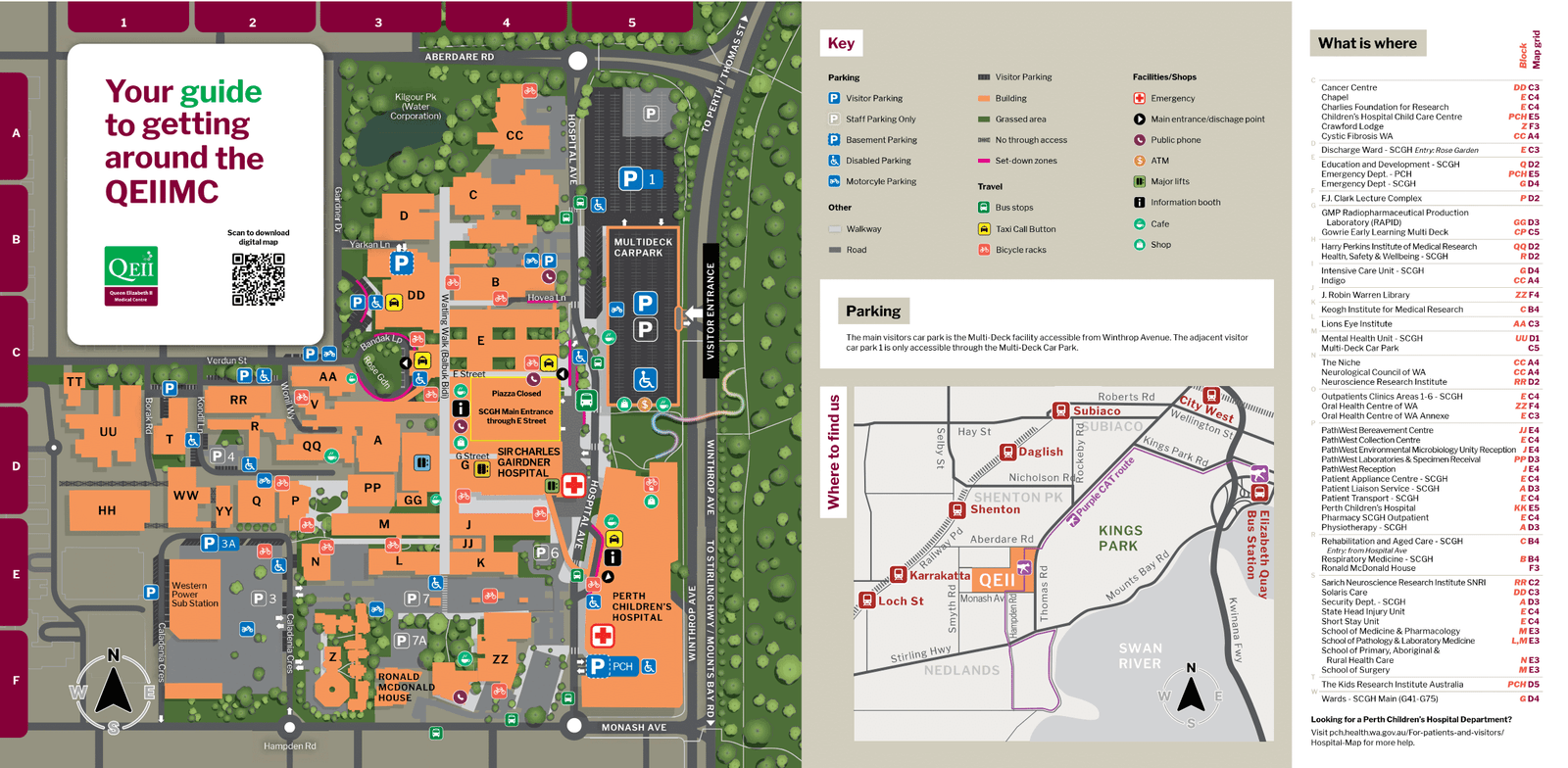
Call Sir Charles Gairdner Hospital switchboard on 6457 3333 and ask for your specific clinic. The Outpatient Audiology and ENT Department is located on E Block, Ground Floor, Area 2 – see the Sir Charles Gairdner Hospital map (external site).
Opening hours
8:00am to 4:00pm, Monday to Friday.