

Telethon grants continue to help kids with peanut allergies through Australian-first trial
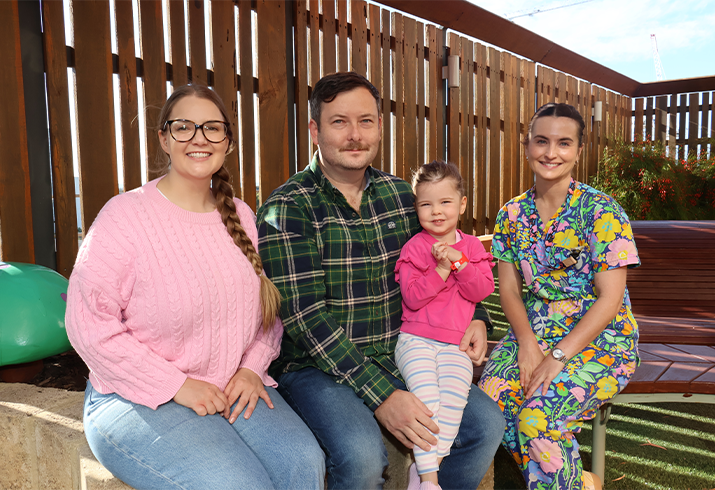
At just 7 months old, Matilda Devenish’s parents had to call an ambulance after their daughter had an anaphylactic reaction to peanuts.
"We'd been going through the usual exposures to allergens that you test with your kids, and it took just three minutes for her to have a severe allergic reaction after we gave her the first taste of peanuts," Matilda's Dad Michael Devenish said.
"It was extremely traumatic, especially as first-time parents.
"Following that experience, we did extensive research to see what we could do to support Matilda and that's when we became aware of the Oral Immunotherapy Trial (OIT) at Perth Children's Hospital.
"Thanks to research funding support from Telethon, the program then opened at Fiona Stanley Hospital (FSH) in mid-2024 and we jumped at the opportunity to become involved – we were lucky to get in from its inception."
Now in its third year, the Telethon funded research study – Reversing Peanut Allergy in Infants – is led by FSH Consultant Clinical Immunologist, Dr Michael O'Sullivan.
The study aims to reverse peanut allergy in infants through early intervention with oral immunotherapy, delivered in the community through collaboration between general practices and allergy specialists.
The research project generates the evidence and expertise to translate this potentially life-changing treatment into a community-based model of care across WA.
"Our unique approach to early intervention for infants with peanut allergy aims to relieve the lifetime burden of peanut allergy on the health and wellbeing of children and their families," Dr Michael O'Sullivan said.
"Delivered in the community through collaboration between specialists in allergy and primary care, our treatment model can be readily scaled up and implemented for the benefit of all WA children with food allergy.
"Most infants don't outgrow their peanut allergy, resulting in peanut allergy being the most common food allergy in school-aged children and children with peanut allergy are at risk of potentially life-threatening anaphylaxis.
"With Telethon's support, at FSH we're conducting an Australian-first study of peanut OIT in infants that draws on our experience with trials of OIT in preschool aged children and strong collaboration with GPs established through the successfully implemented Virtual Immunology Clinic for General Practice."
Eligible children follow a daily dosing schedule of peanut powder, taken at home, over two years.
"We're pretty pragmatic parents but those first few doses were very nerve-wracking," Matilda's Dad Michael said.
"It's taken a lot of discipline, but it's just our way of life now.
"Initially we were told to carry an EpiPen and avoid peanuts which was absolutely devastating – we were apprehensive to travel, take her to birthday parties – all the usual kid stuff.
"Thankfully since being part of the study Matilda has liked doing it all, we've been really lucky, she calls it her 'peanut medicine' and likes the taste of it.
"She has a twin sister Bridget, which has made it quite complicated, but we've tried to make it special for Matilda and she enjoys going to hospital with Mum and Dad."
At the end of the treatment, children have an oral peanut challenge test in hospital to determine if remission of their allergy was achieved and are followed in routine clinical care for at least 12 months to evaluate safety and effectiveness, quality of life, and long-term outcomes.
Matilda, who turned three in June, just finished her final food allergy test ahead of this weekend's Telethon Weekend.
Since 2023, the research team has been the recipients of three Telethon Grants totalling almost $777,000 to support this vital study.
"We're very grateful to Telethon and their ongoing funding commitment to help us set up this long-term research study which provides direct benefit to WA children and their families through this world-leading approach to reverse peanut allergy," Dr Michael O'Sullivan said.
"Our confidence built as the program went on and the support of staff, especially Sam, was just incredible – we've been very impressed with the maturity of program and it's a credit to the FSH Immunology Department," Matilda's Dad Michael said.
"It's really given us a whole new perspective on patient care, outcomes, and health pathways.
"As a parent, you're still going to be apprehensive through the process but to know that there is something that can be done to attempt to desensitise and help your child tolerate nuts, without issue, is very reassuring.
"There is light at the end of the tunnel."
Keep up to date with our news and achievements
Find out more on Facebook (external site) or LinkedIn (external site)