Advance care planning

  • Advance care planning is a voluntary process that allows people to explore what they value most in life, to guide their current and future health and personal care.
  • The values, preferences and treatment decisions that are shared through advance care planning are used by others to guide decision-making at a future time when that person cannot make or communicate their decisions.
  • All health professionals have an important role in supporting and promoting advance care planning.
 

The role of health professionals in advance care planning

  • Identify opportunities to raise advance care planning
  • Assist patients to choose suitable advance care planning documents
  • Have discussions about the patient’s health and treatment options
  • Store advance care planning documents and communicate in clinical handovers
  • Enact and follow treatment decisions when patient doesn’t have decision-making capacity
  • Encourage review of advance care planning documents when patients’ health changes or at least every 2 - 5 years.

 Health professional guide to advance care planning in Western Australia. Features two people talking in one bubble and a picture of a clinician in another. Title of the document is white on a blue to purple gradient  For a step by step guide to supporting patients through the advance care planning process, download the Health Professional Guide to Advance Care Planning in WA (PDF 1.8MB)  or order a free copy.

Why advance care planning is everyone's responsibility

Benefits of advance care planning

  • Provides an opportunity for people to plan what is important for their future health and personal care, and to take comfort in sharing this with others.
  • Enables decision-making to occur by the person without the pressure of acute clinical decline.
  • Assists people to make decisions when they are able to communicate so they receive care that is consistent with their beliefs, values, needs and preferences if they become unable to communicate decisions.
  • Reduces non-beneficial transfers to acute care and unwanted interventions.
  • Improves patient and family satisfaction with care, with families experiencing less anxiety, depression and stress.

Obligations and legislative requirements

A range of legislative requirements also inform obligations for advance care planning:

  • Guardianship and Administration Act 1990
  • Criminal Code
  • Common Law
  • National Quality Standards for health services, general practice and aged care
  • Codes of conduct and professional guidelines.
Principles of advance care planning

WA Health has developed a set of principles to promote a common understanding of advance care planning and consistency in how health professionals support the process in WA. Advance care planning:

  1.  is voluntary, person-centred, and focused on empowering people to have choice and control over their future medical treatment decisions 
  2.  is an ongoing process which the person can engage in at any point in time, and requires regular review allowing a person to make and change decisions as their circumstances and preferences change
  3.  can be undertaken at any age and ideally commences before a person is unwell

  4. is inclusive and can involve as many, or as few, people the person chooses to involve (e.g. family, carers, friends. health professionals, legal professionals)
  5.  should be holistic and respect the whole person, with broad consideration of healthcare needs (i.e. not limited to medical treatments)
  6.  should acknowledge and respect a person’s attitudes towards health and wellbeing, including cultural and spiritual considerations
  7.  is focused on the person’s values, priorities and preferences and encompasses more than the completion of advance care planning documents
  8.  may involve many, and sometimes challenging, reflections and discussions; these may need to be facilitated to ensure the person understands all their options when it comes to planning for their future care
  9.  needs to follow an ethical process and support the person’s right to meaningfully participate in decision-making to the greatest extent possible.
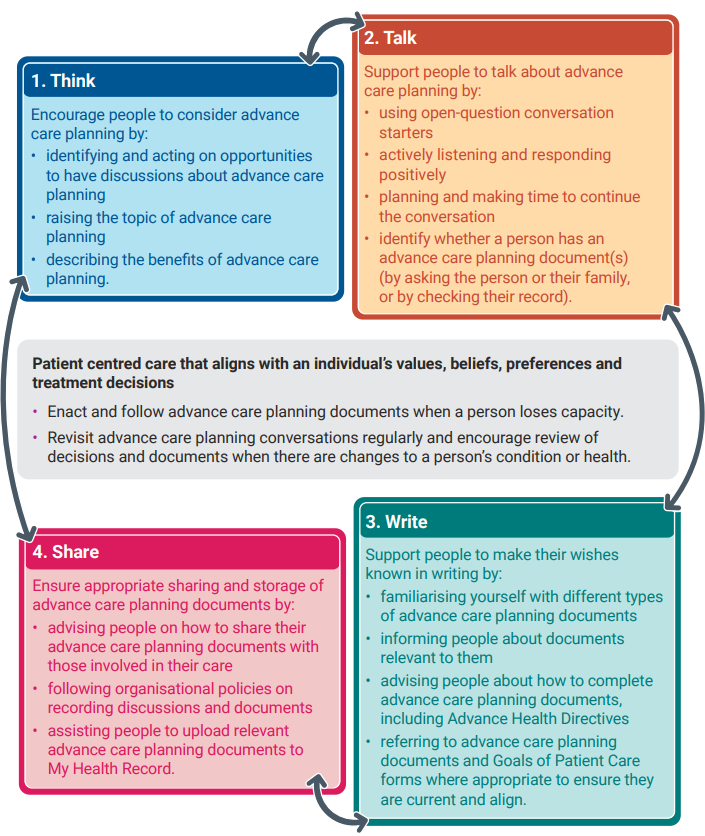
Your role in Think, Talk, Write and Share

There are 4 main elements to advance care planning: Think, Talk, Write, Share.

Health professionals can support people as they move between these elements and change their choices to suit changes in their personal situation, health or lifetyle.

Tip

Seeking clarity on the validity of documents

If you have concerns about the validity of an Advance Health Directive or Enduring Power of Guardianship, and the person has capacity, you should discuss your concerns with the person.

If the person does not have capacity, you should:

Advance care planning documents in WA

More information

Where to get help

Advance care planning information and resources

  • Department of Health WA Advance Care Planning Information Line
    General enquiries and to order free advance care planning resources  (e.g. Advance Health Directives, Values and Preferences form)
    Phone: 9222 2300
    Email: ACP@health.wa.gov.au

Workshops and help with completing documents

  • Palliative Care WA – Advance care planning workshops and support 
    Provides free advance care planning community workshops and the Advance Care Planning Support Service for help with completing documents
    Phone: 1300 551 704 (9:00 am to 5:00 pm Mon to Fri)
    Email: info@palliativecarewa.asn.au
    Palliative Care WA (external site)

Enduring Powers of Guardianship and Enduring Powers of Attorney

Last reviewed: 10-03-2026
Produced by

End-of-Life Care Program